

By Lance Allison, Founder of Ruby Digital Agency | Last Updated: January 27, 2026 | 16 min read
Average Order Value (AOV) is the metric that separates struggling Shopify stores from thriving ones. While most merchants obsess over traffic and conversion rates, savvy store owners know that increasing how much customers spend per transaction is the fastest path to profitability—without spending another dollar on ads.
At Ruby Digital Agency, I’ve completed over 100 Shopify migrations from platforms like BigCommerce, Magento, WooCommerce, and OpenCart. One pattern I see consistently? Merchants leaving massive revenue on the table because they haven’t optimized their AOV strategy. The good news? Small, strategic changes can boost AOV by 20-50% within weeks.
Understanding Shopify AOV: The Basics
Your Average Order Value is calculated by dividing total revenue by the number of orders over a specific period. If you generated $10,000 from 200 orders last month, your AOV is $50.
Why AOV Matters More Than You Think
- Increases revenue without additional marketing spend
- Improves profit margins on existing traffic
- Maximizes ROI on customer acquisition costs
- Creates better customer experiences through strategic bundling
2026 Industry AOV Benchmarks
| Industry | Average AOV |
|---|---|
| Fashion & Apparel | $75–$150 |
| Beauty & Cosmetics | $50–$100 |
| Health & Wellness | $40–$80 |
| Home & Decor | $100–$200 |
| Electronics | $150+ |
| Luxury & Jewelry | $230–$417 |
Top-performing Shopify stores achieve AOVs 68% higher than median performers. That gap represents pure profit potential waiting to be unlocked.
1. Create Strategic Product Bundles That Actually Sell

Product bundling is hands-down one of the highest-impact AOV tactics because it removes decision paralysis while creating perceived value. Research shows properly executed bundles can lift AOV by 55% and increase revenue per user by 86%.
Why Bundles Work
Bundles simplify the buying decision. Instead of customers wondering “which products do I need?”, you present a curated solution that solves their problem in one click. It’s convenience meets value—a combination customers will pay premium for.
Types of Bundles to Implement
Preset Bundles – Curated solutions aligned to customer goals
- Example: “Complete Skincare Routine” (cleanser + toner + moisturizer)
- Works best for: Beauty, wellness, starter kits
- Discount range: 10-20% off individual prices
Build-Your-Own (BYOB) Bundles – Let customers select items within defined parameters
- Example: “Build Your Coffee Bundle – Choose 3 bags”
- Works best for: Food, supplements, fashion accessories
- Creates higher AOV while giving customers control
Volume Bundles – Tiered pricing that makes value obvious
- 1-pack = $30 (standard price)
- 2-pack = $54 (10% savings per unit)
- 3-pack = $72 (20% savings – visually highlight as “Best Value”)
Real-World Bundle Success
A skincare client I migrated from Magento to Shopify implemented a “Glow Kit” bundle combining their top 3 products at 15% off. This single bundle now accounts for 23% of total revenue and increased AOV from $47 to $68—a 45% lift.
Implementation tip: Use apps like Bundler, Kaching Bundle, or PromBundle to create bundles without coding. Place bundle offers directly on product pages and in cart drawers for maximum visibility.
2. Set Free Shipping Thresholds Strategically
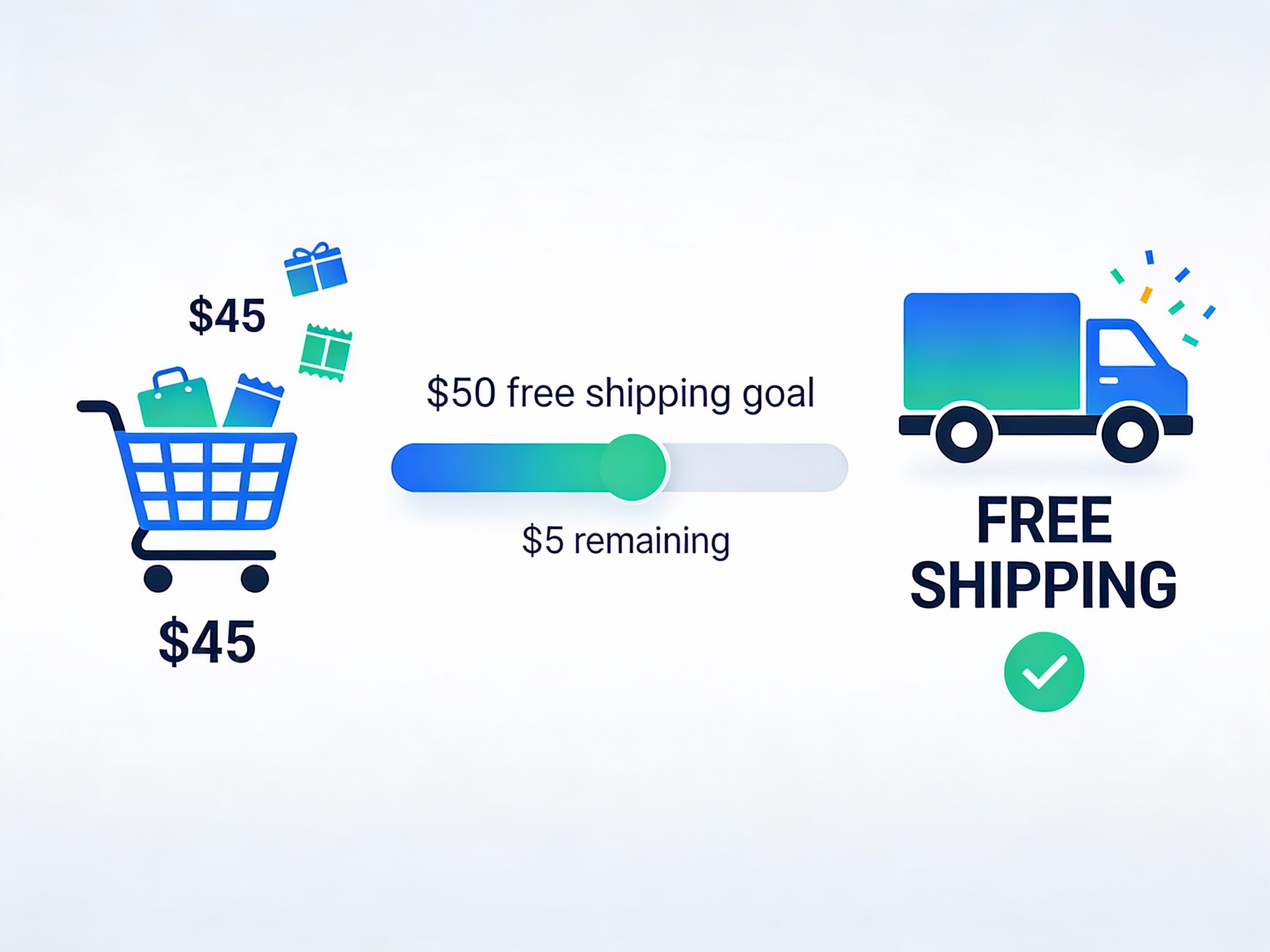
Free shipping is one of the most powerful psychological triggers in e-commerce. 80% of online shoppers will add items to their cart specifically to qualify for free shipping—even if they’re spending more than the shipping cost would have been.
How to Calculate Your Perfect Threshold
Here’s the exact formula I use for every client:
- Determine your current AOV (e.g., $45)
- Calculate average shipping cost (e.g., $8)
- Set threshold 20-30% above current AOV (e.g., $55-$60)
This sweet spot encourages customers to add one more item without making the goal feel impossible to reach.
The Psychology of Progress Bars
Display a dynamic progress bar in your cart showing how close customers are to free shipping. Messages like “You’re only $12 away from FREE shipping!” create urgency and gamify the experience.
What this looks like:
- Customer adds $45 item to cart
- Progress bar shows: “Add $10 more for FREE shipping!”
- Customer adds $15 filler product
- New cart total: $60 (vs. $45 original + $7 shipping = $52)
- You win: Higher AOV. Customer wins: “Free” shipping + extra product
Apps That Make This Easy
- Essential Free Shipping Bar – Customizable progress bars with revenue tracking
- Cart goal thresholds with multiple reward types
- Real-time calculation and mobile optimization
Proven Results
A home goods client increased AOV by 28% within 60 days by implementing a $75 free shipping threshold (previous AOV: $58). The progress bar alone drove a 34% increase in customers adding products to reach the threshold.
Pro tip: Test different threshold amounts. Sometimes $5-10 adjustments can significantly impact both AOV and cart abandonment rates.
3. Implement Smart Upsells and Cross-Sells at Key Touchpoints
Amazon attributes 35% of its revenue to personalized product recommendations. You can replicate this strategy in your Shopify store with the right placement and relevance.
The Difference Between Upselling and Cross-Selling
Upselling = Encouraging customers to buy a premium version
- Example: Standard laptop → Pro model with better specs
- Works best on: Product pages, before add-to-cart
Cross-selling = Suggesting complementary products
- Example: Laptop → laptop bag + wireless mouse
- Works best in: Cart, checkout, post-purchase
Strategic Placement for Maximum Conversion
Product Pages – “Frequently Bought Together” bundles above the fold
Cart Page – “Complete Your Order” recommendations
- Display items that pair with cart contents
- Include “Add to Cart” buttons for one-click additions
Checkout – For Shopify Plus merchants, use Checkout Extensibility
- One-click add-ons that don’t disrupt payment flow
- Focus on low-cost, high-value items ($10-30 range)
Post-Purchase (Thank You Page) – When buying intent peaks
- Offer complementary products at exclusive discounts
- Payment info already stored = zero friction
Real Campaign Performance
I implemented ReConvert for a fashion accessories client, offering post-purchase upsells of jewelry cleaning kits. With an 8.2% conversion rate on these offers, they generated an extra $3,400 in month one without any additional traffic.
Best Practices
- Keep recommendations relevant (AI-powered apps excel here)
- Limit options to 2-4 products maximum (avoid choice paralysis)
- Use benefit-focused copy: “Protect your investment for 15% off”
- A/B test placement and offers continuously
Video resource: How to Increase AOV on Shopify Using Upsell Accessories
4. Launch a Tiered Loyalty Program That Rewards Spending
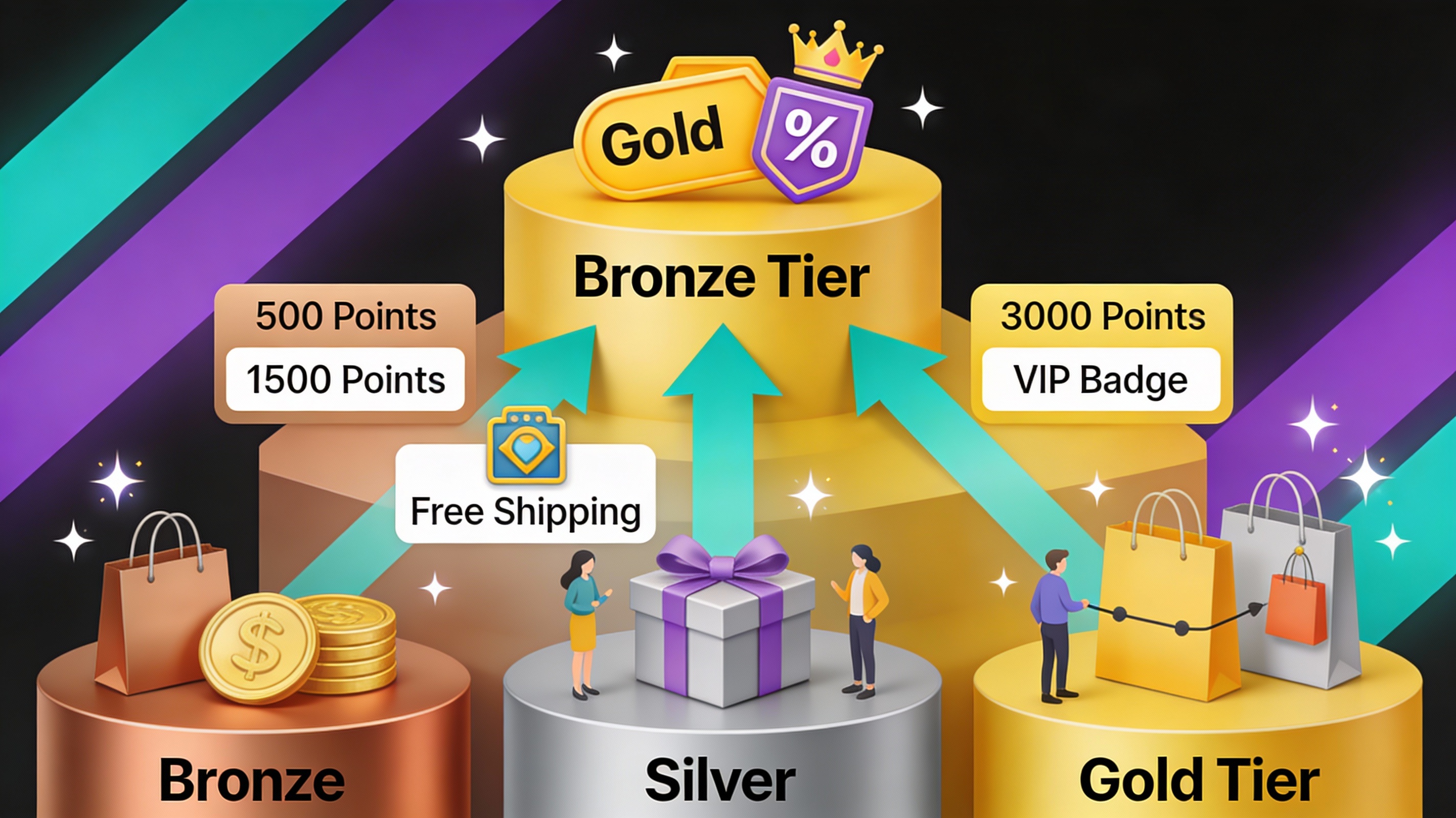
Loyalty programs don’t just encourage repeat purchases—they actively influence how much customers spend per transaction. Well-designed programs increase AOV by 13-75% depending on implementation.
Why Tiered Programs Outperform Flat Rewards
Customers hate leaving points on the table. When they’re close to the next tier, they’ll add items to reach that threshold—it’s basic behavioral economics in action.
How to Structure Loyalty Tiers
Bronze/Basic Tier (Entry level)
- Earn 1 point per $1 spent
- Access to member-only sales
Silver Tier (Unlock at $200 lifetime spend)
- Earn 1.5x points per purchase
- Free shipping on orders $50+
- Birthday reward
Gold/VIP Tier (Unlock at $500 lifetime spend)
- Earn 2x points per purchase
- Exclusive early access to new products
- Priority customer service
- Free shipping on all orders
Bonus Point Multipliers
Guide spending toward high-margin products by offering point multipliers:
- 3x points on new collection launches
- 5x points on specific categories during promotions
- Double points for subscription purchases
Subscription + Loyalty Integration
The most powerful AOV tactic? Combining subscriptions with loyalty rewards. Offer bonus points for subscribing, then additional rewards after milestone deliveries (3 shipments, 6 shipments, etc.)
Apps to implement: Smile.io, LoyaltyLion, or Joy Loyalty Program
Client Success Story
A supplement brand I consulted implemented spend-based tiers with bonus points for auto-ship subscriptions. Their VIP tier customers now have an AOV 68% higher than non-members, and subscription retention improved by 34%.
5. Offer Buy Now, Pay Later (BNPL) to Reduce Purchase Friction
BNPL services like Klarna, Afterpay, Affirm, and Shop Pay Installments remove the psychological barrier of large upfront payments. Customers see “$25 every 2 weeks” instead of “$100 now”—and that reframing dramatically impacts buying behavior.
BNPL Impact on AOV
Merchants consistently report 20-50% AOV increases after implementing BNPL, especially for higher-ticket items ($150+). Cart abandonment drops by up to 28% because price sensitivity decreases when payments are spread over time.
How BNPL Benefits Your Store
You receive full payment immediately from the BNPL provider, even though your customer pays over time. This:
- Improves working capital and cash flow
- Eliminates default risk (provider handles collections)
- Enables you to sell higher-priced items without financing risk
Implementation Steps
- Navigate to Shopify Settings → Payments
- Enable Shop Pay Installments (for US merchants, built-in)
- Add alternative providers via apps:
- Display installment pricing on product pages: “4 interest-free payments of $XX”
Real Impact Numbers
An outdoor gear client added Affirm to their checkout. AOV jumped from $127 to $168—a 32% increase—because customers felt comfortable upgrading to premium products and adding accessories.
Pro tip: BNPL works best when you display installment amounts prominently on product pages, cart, and checkout. The more visible it is, the higher the adoption rate.
6. Use Volume Discounts and Quantity Breaks
Volume pricing creates clear incentive for customers to buy multiple units of the same product. This works exceptionally well for consumables, supplements, fashion basics, pet supplies—anything with repeat-purchase potential.
Effective Tiered Pricing Structure
Standard pricing:
- 1 unit = $30 (full price)
- 2 units = $27 each / $54 total (10% off)
- 3+ units = $24 each / $72+ total (20% off ← Label as “Best Value”)
The Psychology Behind It
When you visually highlight the 3-pack as “Most Popular” or “Best Value” with badges or different colors, customers anchor to that option—even if they originally planned to buy just one.
Display Tactics That Convert
- • Show savings clearly: “Save $18 when you buy 3”
- • Use visual cues: badges, checkmarks, color differentiation
- • Place volume options directly on product pages (not hidden in dropdowns)
- • Include comparison messaging: “That’s only $0.80 per serving!”
Apps: Bundler, Quantity Breaks by Kaching, or PromBundle
Client Performance
A coffee subscription brand implemented 3-tier quantity discounts and increased AOV by 41%. The 3-bag option (previously 18% of orders) now represents 47% of orders—a complete shift in buying behavior.
Implementation timeline: Volume discounts can be set up in 1-2 hours using apps, with results visible within 7-14 days.
7. Create Time-Limited Offers and Scarcity Triggers
Urgency and scarcity tap into fundamental psychological principles—FOMO (fear of missing out) and loss aversion. When used authentically, these tactics increase conversions by 15-30% and boost AOV by encouraging customers to “buy now” rather than delay.
Effective Urgency Tactics
Countdown Timers
- Flash sales: “Sale ends in 4 hours 23 minutes”
- Works best for: Limited-time discounts, seasonal promotions
- Placement: Product pages, cart, announcement bars
Low Stock Alerts
- “Only 3 left in stock – order soon!”
- “12 people have this in their cart now”
- Triggers: FOMO and competitive behavior
Limited-Time Bundles
- “Buy 2, Get 1 Free – Today Only”
- “Weekend Special: Free gift with orders over $99”
- Encourages larger purchases to capture deal
Cart Reservation Timers
- “Items in your cart reserved for 10 minutes”
- Creates urgency to complete checkout
- Reduces abandoned carts
The Golden Rule: Only Use Real Scarcity
Never use fake countdown timers that reset daily or false low-stock alerts. This destroys trust and can permanently damage your brand reputation. Customers are smart—they’ll test your timers and call your bluff.
Where to Display Scarcity Elements
- Product pages (above add-to-cart button)
- Cart page (to encourage immediate checkout)
- Exit-intent popups (last-chance offers)
- Announcement bars (site-wide visibility)
Apps: Hurrify, Stock Countdown, Countdown Timer Bar
Campaign Results
For a seasonal decor client, I added countdown timers to flash sales and real low-stock alerts on bestsellers. During their holiday campaign, AOV increased 22% as customers added more items to “make the most” of limited-time offers.
Learn more: How to Use Urgency & Scarcity to Boost Shopify Order Value
8. Optimize Your Checkout Experience for Mobile
With 70-80% of e-commerce traffic coming from mobile devices, your checkout must be frictionless on smaller screens. Yet mobile AOV consistently trails desktop ($38-40 mobile vs. $95 desktop) largely due to poor optimization.
Mobile Checkout Optimization Checklist
- • Enable one-page checkout (Shopify’s default for new stores)
- • Activate Shop Pay, Apple Pay, and Google Pay for one-click purchasing
- • Minimize form fields—remove unnecessary fields (keep only essentials)
- • Enable address autocomplete via Google API
- • Display trust badges above payment button
- • Show total cost upfront including shipping and taxes
- • Use large, thumb-friendly buttons (minimum 44x44px touch targets)
- • Test on actual devices—not just browser emulation
Form Field Reduction Impact
Research shows reducing checkout form fields from 12 to 6 can increase conversions by 34% because it reduces cognitive load and typing effort on mobile.
Before optimization:
- Full name (2 fields)
- Phone
- Address line 1
- Address line 2
- City
- State/Province
- ZIP/Postal code
- Country
- Card number
- Expiry date
- CVV
= 12 fields
After optimization (with autocomplete):
- Full name (1 field)
- Phone
- Address (autocomplete handles the rest)
- Card details (3 fields combined in modern UI)
= 6-7 fields
Why This Impacts AOV
A smooth mobile checkout builds confidence. When customers trust the process, they’re more likely to add upsells and additional items rather than rushing through checkout to “get it over with”.
My Implementation Standard
Every Shopify migration I complete includes comprehensive mobile checkout testing. For one fashion client, simply enabling express checkout options and reducing form fields increased mobile AOV by 18% and overall mobile conversion by 26%.
Additional resources:
9. Implement Post-Purchase Upsells on Thank You Pages
Post-purchase upsells are the “hidden goldmine” of AOV optimization because they target customers at peak buying intent—immediately after completing a purchase. Conversion rates on post-purchase offers range from 4-12%, and success stories include Zipify generating over $138 million in additional revenue for merchants.
Why Post-Purchase Upsells Work
- • Payment information already stored (one-click acceptance)
- • Customer in positive emotional state (just completed satisfying purchase)
- • Zero friction—doesn’t interrupt original checkout flow
- • Low risk—if customer declines, original sale still complete
What to Offer
Complementary Products
- Bought coffee beans? Add grinder at 15% off
- Purchased laptop? Add laptop bag + mouse bundle
- Ordered skincare? Include travel-size versions
Consumables & Refills
- “Stock up and save 20% on your next refill”
- “Add 2 more for $X (normally $Y)”
Subscription Upgrades
- “Get this monthly and save 20% on every order”
- Convert one-time buyers to recurring revenue
Extended Warranties or Protection
- Especially effective for electronics, furniture
- High margin, low fulfillment cost
Best Practices for High Conversion
- Keep offers highly relevant to what they just purchased
- Limit to 1-2 offers maximum (don’t overwhelm)
- Use clear benefit messaging: “Add to your order for 15% off—one click, no re-entering payment”
- A/B test different offers to find what converts best
- Display on Thank You page AND order confirmation email for multiple touchpoints
Apps for Post-Purchase Upsells
- ReConvert – Drag-and-drop builder with analytics
- AfterSell – One-click upsells optimized for Shopify
- Zipify OneClickUpsell – Pro-level control for high-volume stores
- CartConvert – Pre and post-purchase funnels
Client Success Story
An outdoor gear client uses post-purchase offers for accessories (water bottles, carabiners, patches). With an 8% conversion rate and $28 average upsell value, this generates $4,200+ monthly in pure incremental revenue—with zero additional marketing spend.
Case study: One ReConvert user achieved an 8% conversion rate (vs. 4.7% average) and £21,000 incremental revenue in just 30 days with zero impact on main checkout conversion.
Video tutorial: How to Increase AOV and Profit in 2026 Without Spending More on Ads
10. Leverage Email Marketing with Segmented AOV Campaigns
Email marketing remains one of the highest-ROI channels for driving AOV increases, with segmented campaigns delivering 760% more revenue than generic blasts. The key is sending the right offer to the right customer segment at the right time.
High-Impact Email Segments for AOV
High-Value Customers (Top 20% by spend)
- Offer exclusive early access to new products
- Create VIP-only bundles with premium items
- Send personalized recommendations based on purchase history
Mid-Tier Customers (Close to next loyalty tier)
- “You’re $25 away from Gold status—here’s 15% off to get there”
- Highlight benefits of reaching next tier
- Create urgency with tier-upgrade deadlines
One-Time Buyers
- Cross-sell complementary products they haven’t tried
- Offer “Complete the Set” bundles at discount
- Include social proof from repeat customers
Cart Abandoners with High Cart Values
- Remind them of specific items left behind
- Offer limited-time discount or free shipping to complete
- Segment by cart value (treat $200 cart differently than $50)
Email Types That Boost AOV
Product Recommendation Emails
- “Based on your recent purchase of X, customers also love Y”
- Use purchase history for hyper-relevance
Bundle Promotion Emails
- Feature most popular bundles with clear savings messaging
- Include visual comparisons (individual items vs. bundle)
Threshold Reminder Emails
- “Add $15 more to your next order for free shipping”
- Target customers whose previous orders fell just below threshold
Loyalty Point Balance Emails
- “You have 450 points! Redeem them on your next purchase”
- Include curated products they can “buy” with points
Replenishment Reminders
- For consumables, prompt reorder with quantity discounts
- “Time to restock? Get 20% off when you order 3+”
Apps for Email Segmentation
- Klaviyo – Advanced segmentation with predictive analytics
- Omnisend – Multi-channel automation (email + SMS)
- Mailchimp – Shopify integration with visual workflow builder
Segmentation Strategy I Implement
For subscription-based clients, I set up automated flows targeting customers 5 days before their next shipment with one-click add-ons. This simple tactic increases recurring AOV by 15-22% without any manual work.
Advanced tactic: Use customer lifetime value (CLV) segmentation to identify your most profitable segments, then create exclusive AOV-focused campaigns just for them.
Measuring Success: Track These AOV Metrics
You can’t optimize what you don’t measure. Here’s how to track AOV progress and identify which strategies are working.
Key Metrics to Monitor
Overall AOV – Track weekly and monthly trends
- Goal: Consistent upward trajectory
- Acceptable variance: ±3-5% week-over-week
AOV by Traffic Source
- Email vs. social vs. organic search
- Identify highest-value acquisition channels
AOV by Device
- Mobile vs. desktop vs. tablet
- Target optimization efforts where gaps exist
AOV by Customer Segment
- New vs. returning customers
- Loyalty tier comparisons
- RFM (Recency, Frequency, Monetary) segments
Bundle Performance
- Which bundles drive highest AOV
- Bundle adoption rate vs. individual products
Upsell Acceptance Rates
- Track conversion rates on upsell offers by placement
- Post-purchase vs. cart vs. product page
Free Shipping Threshold Impact
- Compare AOV before/after implementation
- Track percentage of customers hitting threshold
Where to Find AOV Data in Shopify
- Go to Analytics → Reports → Sales over time
- View AOV alongside total sales and order count
- Use date comparison to track changes over time
- Export data for deeper analysis in spreadsheets or BI tools
Set Realistic Goals
First 30 days: 5-10% AOV increase is achievable with quick wins (free shipping thresholds, post-purchase upsells)
60-90 days: 25-50% increases typical with comprehensive strategy implementation
Top performers: The best Shopify stores achieve AOVs 68% higher than median performers
My Measurement Approach
I set up custom dashboards for clients tracking AOV by segment, device, and campaign. This lets us identify exactly which tactics move the needle—and double down on what works while eliminating underperformers.
Common AOV Mistakes to Avoid
After working on 100+ Shopify migrations and optimizations, I see these mistakes repeatedly:
– Setting free shipping threshold too high – If AOV is $50 and threshold is $100, you increase abandonment, not AOV. Keep it 20-30% above current AOV.
– Irrelevant upsells – Suggesting men’s watches to someone buying women’s jewelry destroys trust. Use conditional logic for relevance.
– Too many options – Analysis paralysis is real. Limit bundle options to 3-4 clear choices.
– Fake scarcity – Countdown timers that reset daily train customers to ignore urgency tactics. Only use real deadlines.
– Complicated loyalty programs – If customers can’t understand earning/redeeming in 30 seconds, simplify.
– Ignoring mobile experience – 70%+ of traffic is mobile. Test everything on actual devices.
– Not testing – What works for one store may flop for another. A/B test offers, placements, messaging.
– Over-discounting – Blanket percentage-off discounts usually lower AOV. Use strategic discounts (volume, bundles) that encourage larger purchases.
Your 30-Day AOV Action Plan
Here’s a realistic roadmap to start increasing AOV immediately:
Week 1: Quick Wins
Monday-Tuesday:
- Calculate current AOV and set baseline
- Implement free shipping threshold (20-30% above AOV)
- Add progress bar to cart
Wednesday-Friday:
- Enable post-purchase upsells on thank you page
- Set up 2-3 initial offers testing different price points
- Configure tracking to measure acceptance rates
Expected results: 8-12% AOV lift from free shipping threshold alone
Week 2: Product Strategy
Monday-Wednesday:
- Audit best-selling products for bundle opportunities
- Create 3-5 bundles (preset and/or BYOB)
- Design bundle landing pages or widgets
Thursday-Friday:
- Implement volume discounts on consumable/repurchase items
- Add “Frequently Bought Together” to product pages
- Install recommendation app (Wiser, Glood, etc.)
Expected results: Additional 10-15% AOV lift from bundling strategy
Week 3: Checkout & Loyalty
Monday-Tuesday:
- Audit mobile checkout experience
- Reduce form fields and enable express payment options
- Test on actual mobile devices
Wednesday-Friday:
- Launch tiered loyalty program
- Configure spend-based rewards and tier progression
- Enable BNPL payment options (Shop Pay, Klarna, Affirm)
Expected results: 15-20% improvement in mobile conversion and AOV
Week 4: Testing & Optimization
Monday-Wednesday:
- Set up AOV tracking dashboard
- Implement A/B tests on upsell offers and placements
- Review first 3 weeks’ data and identify top performers
Thursday-Friday:
- Launch segmented email campaigns targeting high-value customers
- Create replenishment flows for consumable products
- Plan next month’s optimization priorities
Expected cumulative results: 15-25% AOV increase by day 30, with continued improvements as you refine
Real-World Success: Case Studies from RDA Clients
Case Study 1: Fashion Accessories Brand
Challenge: AOV stuck at $42, high traffic but low revenue per visitor
Implementation:
- Free shipping threshold at $60 with progress bar
- Post-purchase upsells for jewelry care products
- Volume discounts on earrings (buy 3, save 20%)
Results (90 days):
- AOV increased from $42 to $64 (52% lift)
- Post-purchase upsell conversion: 8.2%
- Additional $10,400 monthly revenue with same traffic
Case Study 2: Supplement Company
Challenge: Low repeat purchase rate, customers buying single bottles
Implementation:
- 3-tier volume pricing (1 bottle / 2 bottles / 3 bottles)
- Tiered loyalty program with subscription bonuses
- Email flows targeting customers 5 days before expected reorder
Results (60 days):
- AOV increased from $38 to $54 (42% lift)
- Subscription adoption: 31% of customers
- VIP tier AOV: 68% higher than non-members
Case Study 3: Home Decor Store
Challenge: Seasonal traffic spikes but inconsistent AOV
Implementation:
- Strategic product bundles (“Complete Room Kits”)
- Limited-time countdown timers on flash sales
- BNPL options for furniture pieces over $150
Results (Holiday season):
- AOV increased from $87 to $118 (36% lift)
- Bundle adoption: 41% of orders included bundles
- BNPL transactions averaged 45% higher AOV than standard checkout
Advanced Strategies: Taking AOV to the Next Level
Once you’ve mastered the fundamentals, these advanced tactics can push AOV even higher:
AI-Powered Personalization
Use machine learning to optimize every customer interaction:
- Predictive product recommendations based on browsing behavior
- Dynamic pricing based on customer segment and purchase history
- Personalized homepage content by returning vs. new visitors
Tools: Rep AI, Nosto, Monetate
Customer Segmentation with CLV Focus
Build sophisticated segments based on customer lifetime value:
- VIP segment (top 10% by CLV) → Exclusive bundles, early access
- Growth segment (high engagement, mid-spend) → Tier upgrade incentives
- At-risk segment (haven’t purchased in 90+ days) → Win-back campaigns with bundled offers
Subscription Optimization
Layer subscription strategies with AOV tactics:
- Subscription-exclusive bundles at deeper discounts
- Upgrade prompts in customer portal near billing dates
- One-time add-ons for upcoming shipments (via portal or email)
Social Proof Integration
Display real-time social proof to reduce hesitation:
- “143 people purchased this in the last 24 hours”
- Live visitor counts on product pages
- Recent order notifications with locations
- Customer photos in product recommendations
Frequently Asked Questions
Q: What is a good AOV for Shopify stores?
A: It varies by industry. Fashion typically sees $75-150, beauty $50-100, electronics $150+, and luxury/jewelry $230-417. The key is comparing your AOV to your own historical data and working to improve consistently. Top-performing Shopify stores achieve AOVs 68% higher than median performers.
Q: How quickly can I expect to see AOV increases?
A: Quick wins like free shipping thresholds and post-purchase upsells show results within 7-14 days. Comprehensive strategies (loyalty programs, bundle optimization) typically show full impact within 60-90 days. A realistic first-month goal is 15-25% AOV increase.
Q: Do upsells annoy customers?
A: Only if they’re irrelevant or intrusive. Well-timed, relevant upsells that add genuine value improve customer experience. The key is matching the right offer to the right customer at the right moment. Post-purchase upsells perform best because they don’t interrupt checkout.
Q: Should I focus on AOV or conversion rate?
A: Both. They work together. Optimizing checkout increases conversion rate. Adding relevant upsells increases AOV. You need a balanced approach that improves both metrics without sacrificing one for the other. The highest-performing stores excel at both.
Q: What’s the best app for increasing Shopify AOV?
A: There’s no single “best” app—it depends on your strategy. For bundles: Bundler or Kaching. For post-purchase: ReConvert or AfterSell. For loyalty: Smile.io or LoyaltyLion. For recommendations: Wiser or Glood.AI. Most successful stores use 3-5 specialized apps working together.
Q: Does offering discounts hurt AOV?
A: It depends on structure. Volume discounts and bundle discounts increase AOV by encouraging larger purchases. Blanket percentage-off discounts usually lower AOV. Use discounts strategically to drive specific behaviors (buy more units, add complementary products) rather than just reducing prices.
Q: How do I calculate my free shipping threshold?
A: Take your current AOV and add 20-30%. If your AOV is $50, set free shipping at $60-65. This creates an achievable goal that encourages one additional item without being so high that customers abandon. Test different thresholds to find your optimal amount.
Q: Can I increase AOV on mobile devices?
A: Absolutely. Mobile AOV trails desktop ($38-40 vs. $95) largely due to poor checkout optimization. Enable one-page checkout, express payment options, reduce form fields, and add progress bars. These changes can increase mobile AOV by 18-25%.
Final Thoughts: Your AOV Is Your Secret Growth Lever
Increasing your Shopify AOV is one of the most cost-effective ways to scale your store. While competitors burn budget on customer acquisition, you’re maximizing the value of visitors already in your funnel—that’s smart business.
The strategies I’ve shared aren’t theoretical—they’re battle-tested tactics I’ve implemented across 100+ client stores during migrations from BigCommerce, Magento, OpenCart, and WooCommerce to Shopify. The merchants who execute these consistently see 30-50% revenue increases without spending a dollar more on ads.
Start with quick wins:
- Free shipping threshold with progress bar (Week 1)
- Post-purchase upsells (Week 1)
- Strategic product bundles (Week 2)
Then layer in:
- Tiered loyalty programs (Week 3)
- BNPL payment options (Week 3)
- Email segmentation (Week 4)
Track your results, test relentlessly, and optimize based on data—not assumptions. Your customers are already in your store. Help them spend more while getting more value in return. That’s the definition of a win-win.
Need Expert Help with Your Shopify Store?
At Ruby Digital Agency, I specialize in Shopify migrations and conversion optimization. Whether you’re looking to move from another platform or need expert implementation of these AOV strategies, I’m here to help.
What I Offer
- • Complete platform migrations (BigCommerce, Magento, WooCommerce, OpenCart → Shopify)
- • Custom theme development and optimization
- • Conversion rate optimization (CRO) audits
- • AOV strategy implementation and testing
- • App integration and configuration
- • Ongoing growth strategy consultation
Related Services
- Shopify Migration Services – Seamless platform transitions with zero data loss
- Shopify Plus Development – Enterprise-level customization and optimization
- E-commerce Conversion Optimization – Data-driven testing to increase revenue
- Custom Shopify Theme Development – Branded, high-converting storefront design
Contact Ruby Digital Agency | Email Lance | Read More on Our Blog
Share This Guide
Found this helpful? Share it with fellow Shopify merchants:
Additional Resources
External Resources
- Shopify’s Official Guide to Average Order Value
- Shopify App Store – Bundle Apps
- Shopify Migration Checklist
- Loop Subscriptions – Post-Purchase Upsells Guide
Recommended Videos
- How to Increase AOV on Shopify – No Apps Required
- Bundle Products on Shopify to Increase AOV
- Post-Purchase Upsell Strategies